
Newest Updates
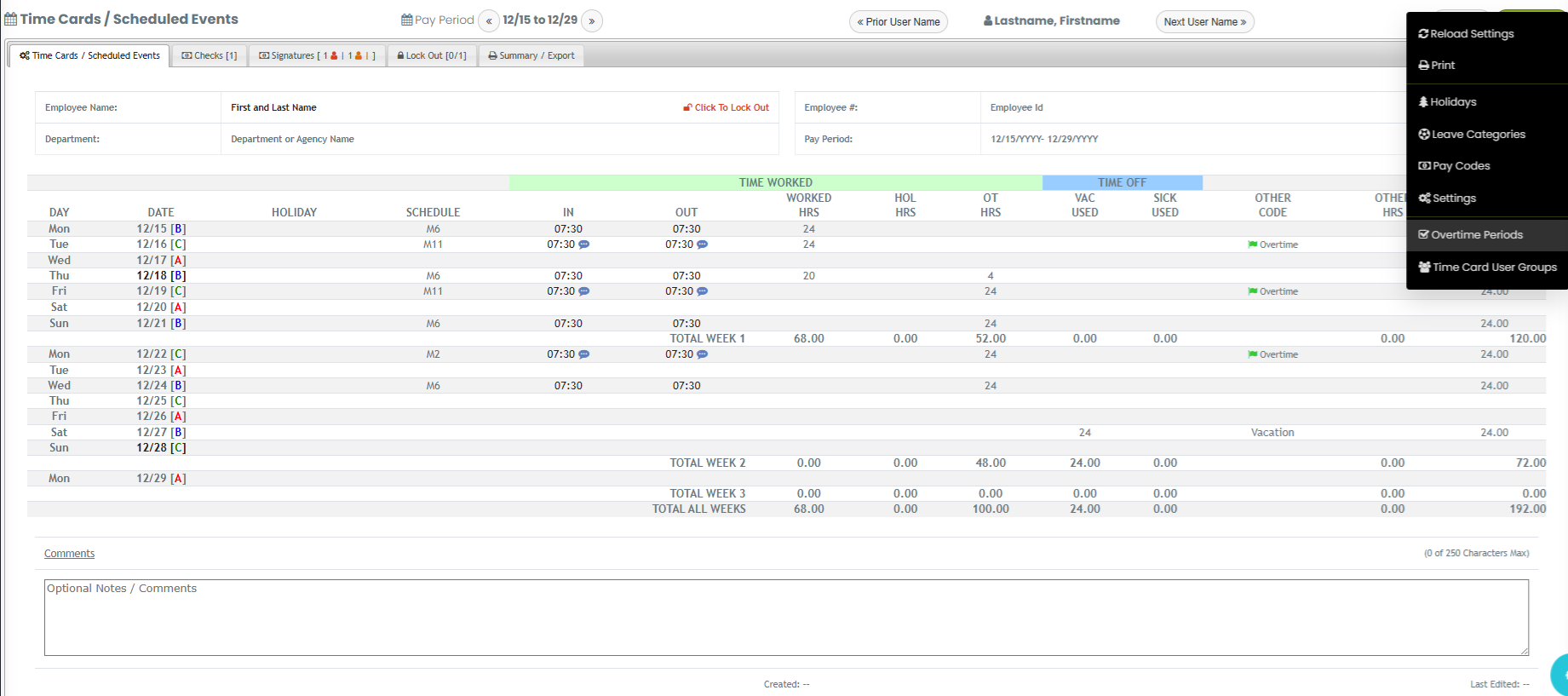
We have just completed a full re-write of the payroll system to allow for much faster calculations and standardization of our coding. This allows us to quickly add any custom exports, rules, and customization that organizations frequently need. Additionally, we can more easily integrate with many more payroll systems. We have also added lock outs for individual users/groups, editing of events from the time cards, improved printing, print headers/footers, and several tools to speed up the payroll verifications. If your agency needs any custom rules, validations, exports, or changes, we are glad to assist with any of those too! Keep reading for an overview of many of the payroll features and concepts.
Time Cards vs Time Stamps
If payroll is generated based on the schedule, this is known as “Time Cards”. If payroll is generated based on Clock In/Out and Time Stamps, this will be “Time Stamps”. Both formats are the same, but will generate the totals from different data sets. There are several ways to know if you are looking at timestamps or timecards. The page title will indicate which data source (Schedule vs Time Stamps) and the Schedule column will show the position name when using Time Cards (Schedule) instead of the scheduled times being displayed in the Schedule column. Pay codes, Over time thresholds and all settings will apply to both versions.
Running Payroll
To view or finalize payroll, click on Schedule > Time Cards / Time Stamps. Select the pay period and filter by cost center if needed. If any names are missing, change the cost center to “All”. You can double click on any name to move to the selected users list. You can also highlight several names at once or click select all, followed by the Add Users button. Once all users have been selected, click the Generate button to display the time cards.
General Settings
There are many settings that you can customize for how payroll will be generated. Options include ignoring daylight saving time, rounding of times, Splitting shifts at a specific time of day, and how to handle events that are crossing over a pay period end. The hard stop at the end of a pay period setting will crop any user hours at the end of the pay period time. If a user works over this time then the remaining hours will be shown on the next pay period. Agencies where all hours are counted on the starting date should leave the hard stop turned off
Overtime Calculations
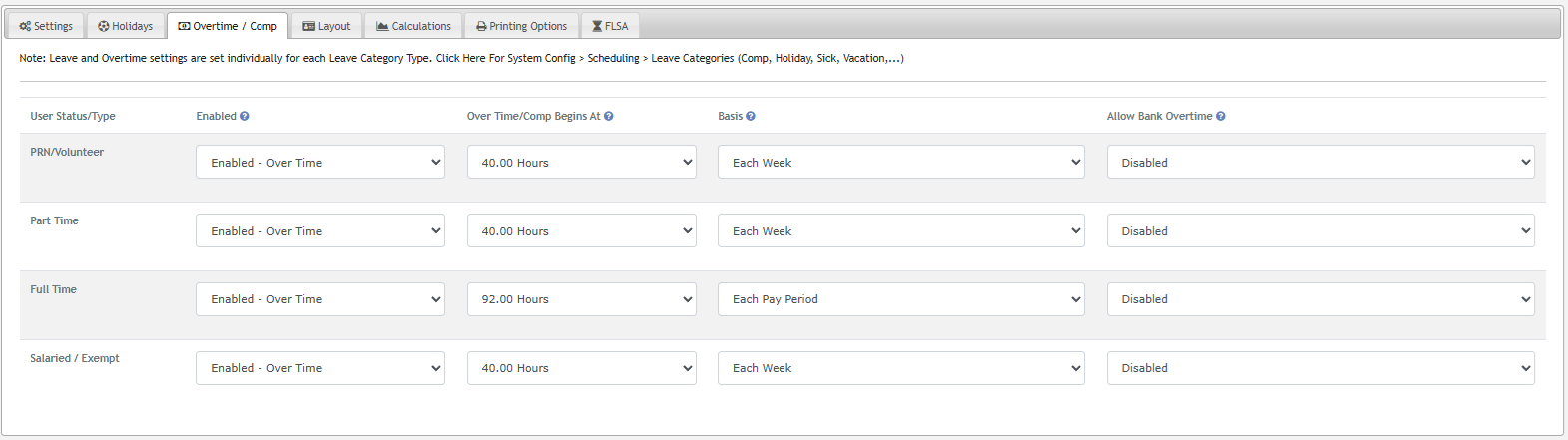
There are many different ways to calculate overtime for individuals. Rules can be based upon the user status such as part time full time and salaried. For customizations on a user level there are additional options as well. Users can be assigned to an overtime group which has rules that will supersede the status rules. Furthermore you can customize the overtime amounts on a individual user level by clicking on the users profile then Employment tab > Miscellaneous > Override OT/Comp Settings. Overtime can be calculated weekly, by pay period, and monthly. Additionally, the overtime periods allow for further customization such groups of people having their pay week start on different days of the week. FLSA rules can also be utilized as well. In the case of a 14 day pay period with a 28 day cycle, we can “look back” at the prior pay period and carry those hours into the OT amounts.
Use the “Settings” quick link in the top right of the time card page or System Config > Time Cards > General Settings > Overtime Tab.
To customize the Overtime rules for a specific person, Navigate to their profile and click on Employment tab > Miscellaneous > Override OT/Comp Settings.
Use the “Overtime Periods” quick link in the top right of the time card page or System Config > Time Cards > Overtime Periods to assign users and rules to groups of staff.
Paycodes
Pay codes can be assigned when specific situations occur. Each agency will have pay codes for regular versus overtime, holidays, incentive codes and more. Each of these pay codes can be fine tuned to override pay amounts, contribute towards overtime, include in exports to payroll platforms and more. Peacoats can also be limited based on a user status and job title to ensure that the appropriate pay code gets used on the correct personnel. Each pay code will have a name that you can set for quick reference And two output codes. The first will be used for regular pay when the user has not hit the overtime threshold and the second code will be used once the user surpasses the overtime threshold. These codes can be the same or different depending on your needs. Each of these also has a multiplier that can modify the hours as needed (0.25x, 0.5x, 1.5x etc).
Each pay code will also have one or more usages that tell the system when to utilize this pay code. The usage could be a specific position, leave category, leave hours type, flags, incentives, days of the week, holidays and more.
Use the “Paycodes” quick link in the top right of the time card page or System Config > Time Cards > Pay Codes.
Holidays
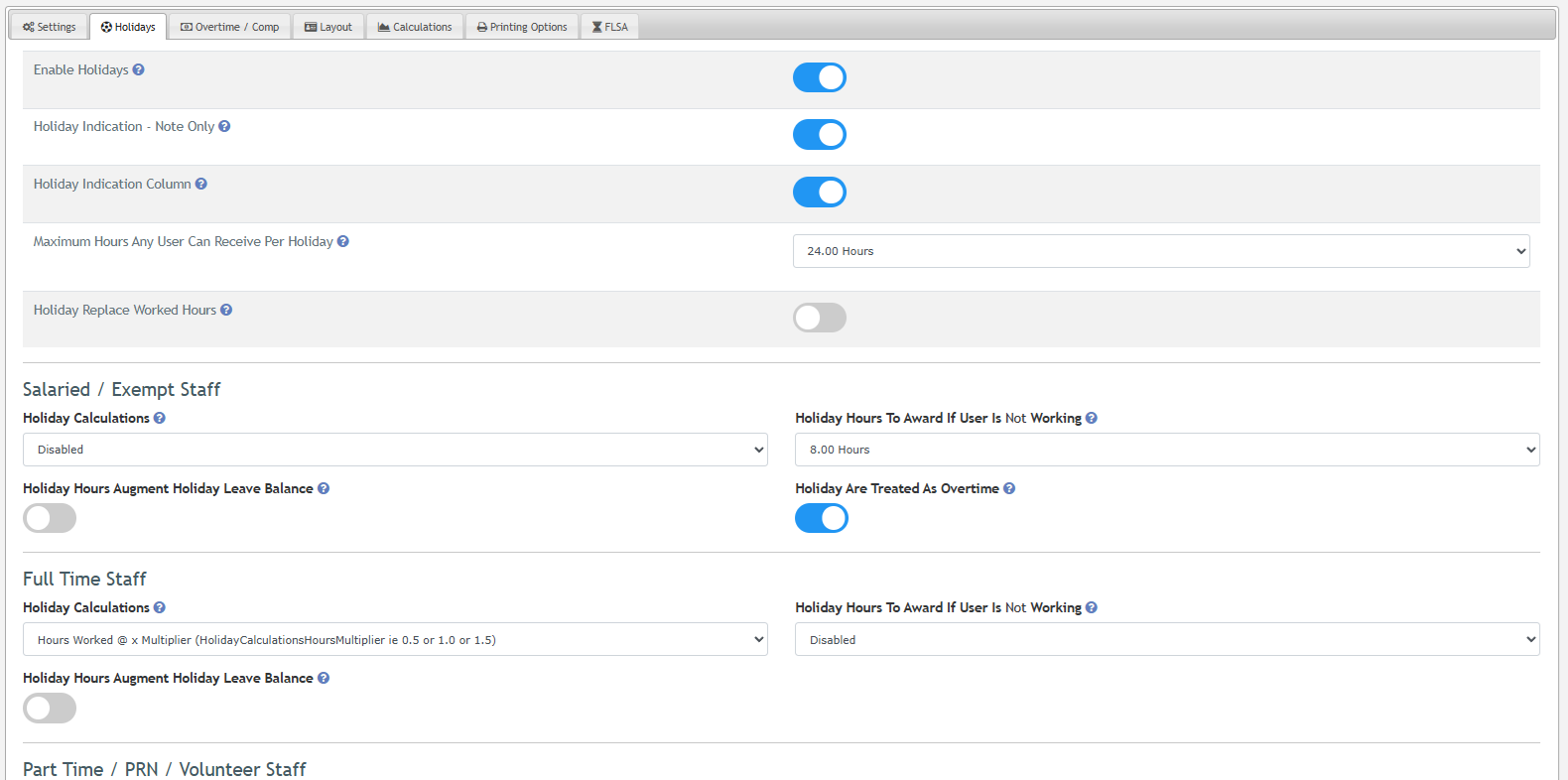
There are many different ways to handle Holidays and ensure the correct personnel are paid accordingly.

If no Holiday pay codes have been defined then no holiday awards can occur. Always ensure a defined holiday code has been created for your organization.
There can be multiple holiday codes for varying levels of staff in situations. The holiday calculations are broken down by salaried full time and part time staff. This will let the system know that this should be a fractional amount such as hour for hour or other options such as a specific amount regardless of the amount of time they are working. Use the holiday hours to award if user is not working to set a specific amount to award when no hours physically worked or leave categories that are enabled as worked hours. Use the settings to augment the leave balance which will award the users hours into their available time off banks when a holiday occurs.
Show some infrequent situations occur when a user is working a holiday that they should not receive the regular pay code but should receive the holiday instead. For this you will select Holidays replaced worked hours as enabled. This will tell the system not to utilize the regular code and only utilize the holiday code for those hours.
Use the “Settings” quick link in the top right of the time card page or System Config > Time Cards > General Settings > Holidays Tab.
Specific Holiday, Amounts and Dates
Next, We need to define how each holiday will operate. Holidays can be customized per occurrence if needed And all holidays must be created for your organization year to year as these dates will change in different counties may award different holidays. See system config Timecard Dash holidays to use our Quick Add feature for the holidays. This will also include observed holidays when the holidays occur on the weekend. Another feature in the holiday definitions will be multiplier amount for holiday or the specific amount for that holiday.
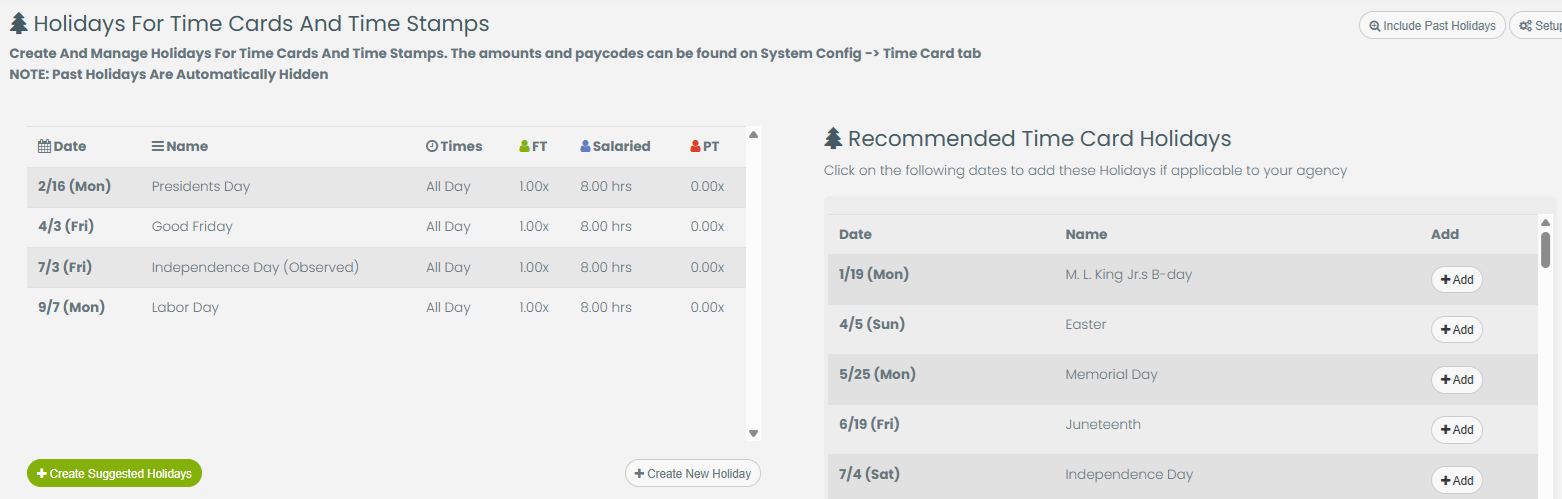
In the situation above these holidays have been defined as an all day event operating from midnight to midnight. You can also customize the times such as 7:00 AM in the morning until 7:00 AM the following day. Full time staff are set up on a multiplier awarding one hour for every hour worked while salaried staff receive a blanket 8 hours per holiday. This can be customized between holidays and extend to part time staff if needed. Click the create suggested holidays to open the typical holidays utilized. You can always add additional holidays with the Create new Holiday button.
Use the “Holidays” quick link in the top right of the time card page or System Config > Time Cards > Holidays.
Leave categories
When staff requests time off, they will select the category and the hours think if the category is a deducting leave category. Typical non deducting leave categories are administrative leave where the user does not need to use their sick, holiday, vacation balances and will not be present at work. Pay codes can be triggered by the leave category and/or by the leave hours bank. Each leave category can be set as deducting from their bank or non deducting. Additionally you can also set if this leave category counts towards the overtime thresholds and applies as working hours towards holidays.
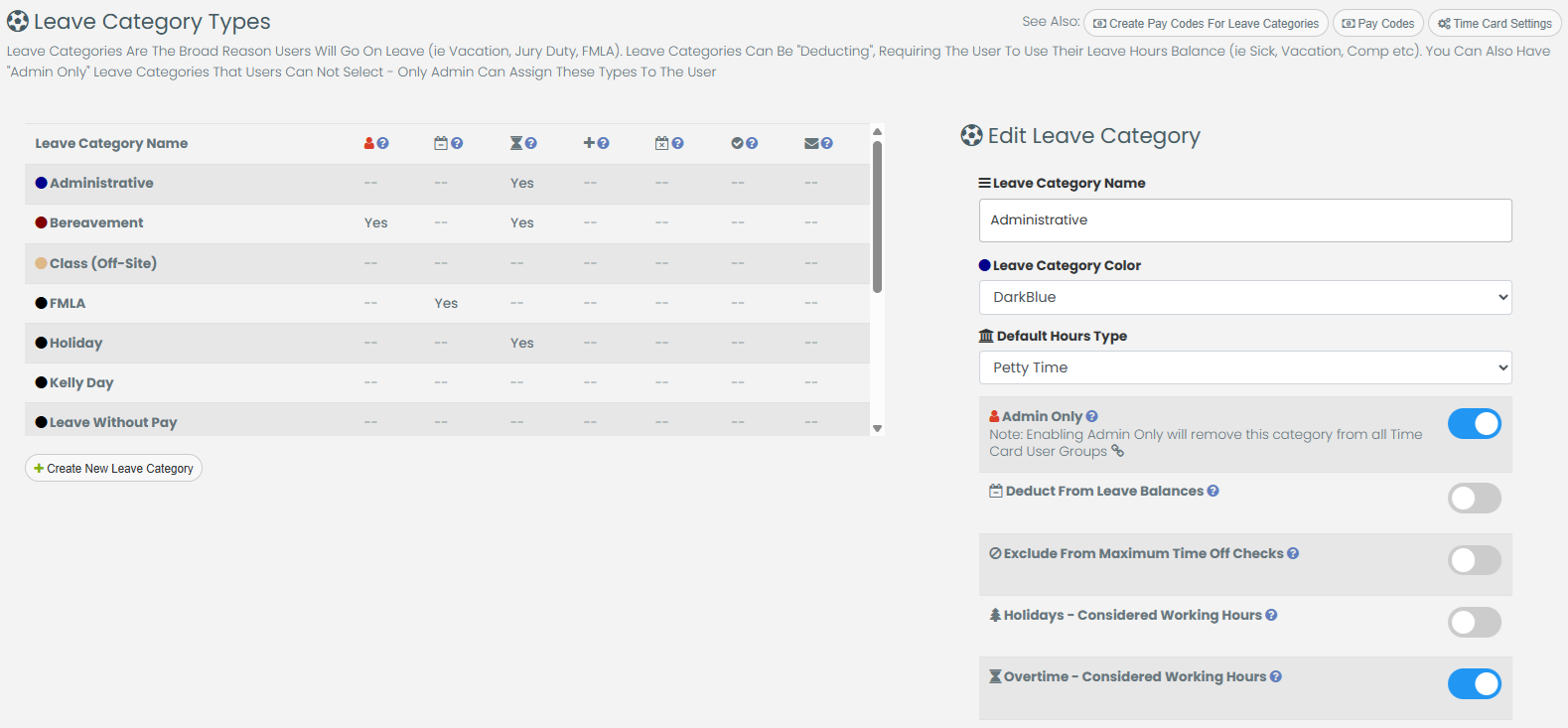
Use the “Leave Categories” quick link in the top right of the time card page or System Config > Scheduling > Leave Categories.
If a leave pay code is not shown in the time cards ensure that the leave category used has not been excluded from the time cards. Also check that the pay code matches that leave category. Some pay codes can also be restricted from the time card page and ensure that this is not set for that pay code
If the leave category is counting as worked hours / overtime thresholds when it should not be, select leave categories from the quick links in the top right insert that leave category as not contributing to worked hours.
Lock out
Once all changes have been made for the pay. You will click lockout for all staff or specific users. This will award any leave hours to the staff and prevent further changes to this pay period and staff. Time cards can be unlocked as well which will remove the hours awarded and allow edits.
Signatures
Employees and up to two supervisor signatures are available. This can be customized in System Config > Time Cards > Settings. You can rename the signatures and decide how many should be visible. Staff can then quickly click sign their timecard to record the date time and IP address of the signature. Supervisors and additional admin staff can quickly cosign many time cards at once from the Signatures tab.
Payroll exports and lockouts can be performed even if some staff have not signed their time cards.
Payroll exports
There are many different payroll export options available. Contact your representative to enable an export to any platform. These integrations can be server to server or it can be a CSV excel file that is manually uploaded into the system. If your payroll provider is not listed just let us know as we are constantly adding additional export options.
Customizations
We can quickly add customizations for your organization as well. Common customizations including checks and balances when certain situations occur, maximum hours worked per week alerts, overtime generated along with leave used and more. We have flexibility on the layout as well so feel free to reach out to your representative for customizations needed.